Frequently Asked Questions
Email info[at]umbc-gradworkers[dot]org for more information!
Your Title Goes Here
Your content goes here. Edit or remove this text inline or in the module Content settings. You can also style every aspect of this content in the module Design settings and even apply custom CSS to this text in the module Advanced settings.
What is the UMBC Graduate Student Workers Union (UMBC-GSWU)?
The UMBC-GSWU is an organization of graduate students who are also employees of the university (like Teaching Assistants, Research Assistants, Graduate Assistants, and Fellows). We are organizing to form a union to democratically improve our working conditions, pay, and benefits through collective bargaining. By joining together, we have a stronger, more effective voice to negotiate with the UMBC and University System of Maryland (USM) administration.
Forming a union with the United Auto Workers (UAW) in particular means joining more than 120,000 higher education employees who are already UAW members. With other academic unions across the country, graduate workers at UMBC will have the political power to impact policy and funding decisions on the local, state, and federal levels.
Are fellows included in UMBC-GSWU?
Yes! Fellows do the same work as other graduate workers and are invited to sign union authorization cards. Fellows are included in many other graduate worker unions around the country.
Why do graduate student workers need a union?
While many of us love our research and teaching, we are also employees who perform critical work that makes the university run. A union provides the legal framework to negotiate with our employer as equals and reach a legally binding contract. It also will strengthen the voice of researchers and teachers in an increasingly difficult political environment.
Without a union, the administration has the unilateral power to set our stipends, change our health insurance plans, increase our fees, or alter our working conditions without our input. With collective bargaining, grad workers set our priorities and our agenda—and we elect fellow grad workers as representatives to negotiate on equal footing over issues such as:
- Fair and regular increases to stipends and wages.
- Comprehensive and affordable health, dental, and vision care.
- Protections against harassment, discrimination, and overwork.
- Clear grievance procedures for when problems arise.
- Benefits like paid parental leave and dependent care support.
- Timely pay and preventing sudden changes to our appointments.
What is collective bargaining?
Collective bargaining is the legally protected process where employees, through their union, negotiate with their employer as a single group. The goal is to produce a written, legally binding contract (a “Collective Bargaining Agreement” or CBA) that outlines wages, hours, benefits, and other terms and conditions of employment. This contract is democratic: it is negotiated by a committee of our peers and does not go into effect until it is approved by a majority vote of all union members.
What improvements have graduate workers bargained for at other universities?
To name just a few gains, academic workers at other universities have successfully negotiated higher wages, better benefits, protections from harassment, discrimination, and abusive conduct, protections from unfair termination, greater support for dependent children, greater support for international employees, and more transparent workplace policies. Critically, these improvements are part of a legally binding contract, which makes them enforceable. See what other grad unions have won here.
Can a union guarantee any specific improvements?
Graduate workers make up our union and will democratically prioritize which improvements to pursue in contract negotiations. With a union, graduate workers will negotiate as equals with the administration for the changes we want to make.
A contract will legally secure those improvements against unilateral changes by the administration. Currently, the administration can change policies and benefits unilaterally, without any obligation to consult those affected. With a union, we will vote on our contract. If we are unsatisfied with a contract, we can vote against it and go back to the negotiating table to work out a better agreement.
Who would be in the union?
The union would include all graduate student employees who receive pay from the university for their work, including Teaching Assistants (TAs), Research Assistants (RAs), Graduate Assistants (GAs), and Fellows.
How is a union different from the Graduate Student Association (GSA) and the Graduate Assistant Advisory Committee?
GSA and GAAC do not have the power to engage in collective bargaining, and thus do not give us an equal voice in the issues which affect us. The GSA can make recommendations, but the UMBC administration is not legally obligated to listen to or implement them.
A union is a legally recognized labor organization with the exclusive power to negotiate a legally binding contract with the university. Many of the graduate workers who launched this campaign have participated in these organizations but have seen that they are not sufficient for addressing concerns about our working conditions.
Do we have the legal right to form a union in Maryland?
Right now, state law in Maryland does not require the university to recognize our union and bargain collectively with us. Bills to expand that right to us have been introduced several times in the past and failed due to the University System of Maryland’s opposition. Graduate unions at private universities (like Columbia, Harvard, and Johns Hopkins) have collective bargaining rights under the National Labor Relations Board (NLRB), but as public employees, we fall under state law.
Like our colleagues at UMD, our organizing strategy is twofold:
- Demonstrate Majority Support: By signing union authorization cards, we show the university and state legislators that a “supermajority” of graduate workers at UMBC wants a union.
- Change the Law: This overwhelming support is the most powerful tool we have to pressure the Maryland General Assembly in Annapolis to pass a law that grants collective bargaining rights to all graduate employees in the University System of Maryland.
Many other groups of grad workers have been able to get laws changed to extend to them the right to collective bargaining after starting union campaigns, including University of Washington, University of California, University of Connecticut, and Columbia University.
What is the process of forming a union?
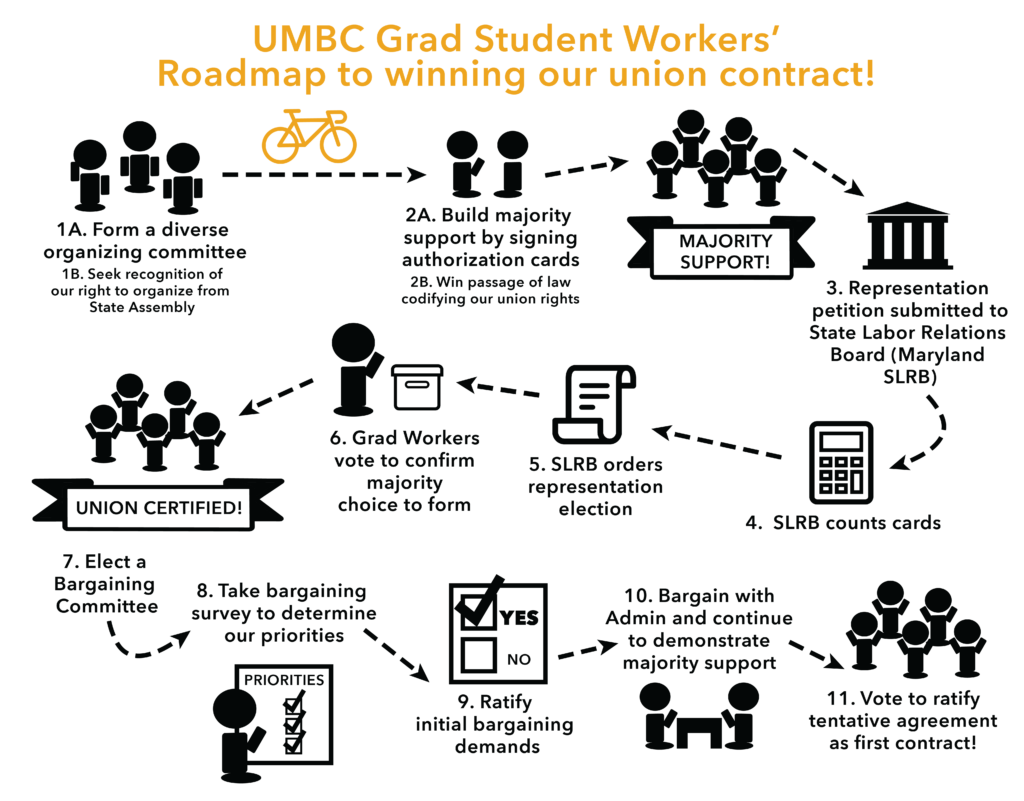
What is an authorization card? How do I sign it?
UMBC graduate student workers are asking colleagues to sign union authorization cards. These say that graduate student workers want the union we are forming — UMBC Graduate Student Workers Union-UAW — to represent graduate student workers in collective bargaining with UMBC Administration.
We don’t currently have the right to collective bargaining. A law has been introduced to grant us this right every year for many years, and it has repeatedly failed due to opposition from the University System of Maryland. By a supermajority of graduate workers signing authorization cards, we can show the University and Maryland legislators that we are ready to bargain and create greater pressure to get the law passed.
Ready to sign a union authorization card? Click here to sign a card.
Why did graduate workers at UMBC decide to organize with the UAW?
In the Summer of 2025, graduate workers involved in organizing at UMBC decided to seek affiliation with the UAW. The UAW is the union with the largest number of graduate student workers in the US, and has a history of successfully expanding collective bargaining rights in the academic sector. Furthermore, the tens of thousands of student workers who have unionized with the UAW and won contracts for their workplaces demonstrate a proven track record of success. Graduate workers at UMD are also organizing with the UAW, and we are working together to secure our rights to collective bargaining and win our unions.
The UAW is the International Union, United Automobile, Aerospace and Agricultural Implement Workers of America (UAW). The UAW has historically been one of the largest and most diverse unions in North America. In recent decades, 120,000 employees in higher education have joined UAW, making it the single largest union of higher ed academic employees in the US. Academic employees from the University of California, Harvard, UConn, Columbia, University of Washington, and many other universities have found that joining the UAW has allowed them to democratically determine priorities as a workforce and dramatically increase power to win improved rights and benefits through collective bargaining.
Will I have to pay dues?
Membership dues are important because they provide the resources necessary for effective representation. As part of the UAW, we would not pay dues until we have gone through the bargaining process and voted democratically to approve our first contract. Dues are critical for providing us with independent resources that are not controlled by the University: we use them to ensure we have appropriate legal, bargaining, community and staff support to represent all UMD graduate student workers. UAW membership dues are currently 1.095% of gross monthly income for public employees without a legal right to strike, and can only be increased by membership action (the membership in a few local unions, for example, have voted to increase dues above 1.095% to have more resources). There is also a one-time initiation fee, which is determined democratically in local union bylaws approved by members.
The value of increased wages and benefits in the first contract typically outweighs the cost of dues, often leading to overwhelming majority approval of those agreements. For example, graduate student workers at Columbia won a minimum of a 6% increase for an after-dues minimum 12-month salary of $43,100 for the 2021/2022 academic year, plus guaranteed salary increases in subsequent years.
PIE CHART NEEDED. How much are dues, and what are they used for?
Dues in the UAW for public sector members without the legal right to strike are 1.095% of gross income and no UMBC graduate student worker will pay dues until after a contract has been democratically ratified. There is also a union initiation fee, which in other UAW student worker unions is $10 and paid one time upon each member’s initial sign-up. Union members, including UMBC graduate student workers, democratically decide how union dues are spent.
Local Union expenses throughout the year are approved by a democratically-elected Executive Board of student workers and the membership of the Local Union. Typically, Local Unions also draft and approve a budget at the start of each year. Trustees elected by Local Union membership also audit the union’s income and expenditures twice annually.
Most of the work of enforcing the contract and representing membership is financially supported by the Local Union. The Local Union receives 27% of its dues to support the following:
- Educating new employees about their rights and the union
- Contract negotiations
- Advising members in difficult situations and supporting them through contract enforcement grievances
- Events, including educational seminars on topics like visa and immigration rights, healthcare, and taxes
- Advocacy for public policy that supports research and researchers
- The Local Union may also receive an additional “rebate” if the Strike and Defense fund is over $500M.
Another 26% of dues goes to the International Union’s General Fund, which provides technical support for contract negotiations and helps other workers successfully form unions (including UMD Graduate Labor Union). The remaining dues are allocated to the Strike and Defense Fund (44%) and Community Action Program (3%). Depending on the overall financial health of the Strike and Defense Fund (if the balance is $500M or greater), an additional allocation of dues called a “rebate” is given back to the Local and International Union.
Some of the ways International Union dues will support UMD Graduate Labor Union members include:
- Providing experienced negotiators, researchers, and legal help to aid UMD graduate student workers in achieving their goals at the bargaining table
- Legal advice and advocacy to impact policy makers, especially those in Washington, DC. For example, in 2025 UAW joined lawsuits against the Trump administration’s funding cuts, surveillance of international academic workers, and unjust changes to visa policy.
- Guidance on grievance and arbitrations. For example, UAW International aided UC Berkeley Teaching Assistants in winning millions of dollars in unpaid tuition remission.
- Helping to win political support for our priorities as academic workers
In addition, dues help support new organizing campaigns. For example, the organizing staff and legal support for the UMD Graduate Labor Union campaign is paid by current UAW members’ dues. Also, union dues have gone towards legal and organizing resources that have have been key to major victories for academic workers including:
- The landmark 2016 NLRB decision extending collective bargaining rights to Graduate Employees at private universities such as Penn, as well as the organizing resources that led to the subsequent representation election victory of Columbia University Graduate Employees.
- The passage of California law SB 201, which was the culmination of a decades-long fight to extend collective bargaining rights to Student Researchers at UC.
- A portion of dues money also goes to support political action, including legislative and other policy advocacy on issues that matter to UAW members. For example, UAW advocates strongly for fair, comprehensive immigration reform, which would include more visa access and an improved green card process, and expanded federal support for research funding, among other topics. [NOTE: Legally, dues money cannot be used for federal campaign contributions, such as the presidential race—that money comes from members’ voluntary contributions separate from, and in addition to, dues, in a program called VCAP (Voluntary Community Action Program)].
Can the university or my advisor retaliate against me for supporting the union?
We all have a legal right to organize for better working conditions with our colleagues. You cannot legally be retaliated against in any way by your PI or by UMD management. We also have safety in numbers, if a majority of graduate workers support the union, we can’t be singled out as individuals.
How would a union affect my relationship with my advisor/PI?
A union contract clarifies the employment relationship, not the academic one. By setting clear, university-wide minimums for pay, benefits, and leave, a contract can actually improve advisor-student relationships. It takes the burden of negotiating for a living wage off the individual student and advisor, removes ambiguity about work expectations (like working on holidays), and provides a formal, neutral process (grievance procedure) to resolve conflicts if they arise. This allows advisors and students to focus on what matters: research and mentorship.
Will signing authorization cards or organizing for a union (such as attending rallies or meetings) threaten my visa status or future visa / green card applications in any way?
Since international students in the U.S. have the same legal rights to participate in unions as U.S. citizens, signing an authorization card should not jeopardize or delay application for legal permanent residence. Authorization cards that get submitted to the Maryland public employee labor board are not released to UMBC or other government agencies. Thousands of graduate workers and other academic workers have signed union authorization cards in large unionization drives across the country since 2008, without any reported instance of delay or rejection of applications as a result of signing a card or otherwise participating in a unionization effort. If you have any questions about your particular situation, please email for additional resources.
Will a union advocate for and prioritize the needs of international students and/or undocumented students?
International students have been central to the leadership and goals of student worker unions around the country. Once we form a union, we will be able to negotiate with UMBC over the workplace issues that affect international and undocumented students.
Will being part of a union affect my taxes? My student status allows me to apply certain deductions as a result of tax treaties with my home country.
No. Unionized graduate workers at other universities in the U.S. are able to participate in tax treaties.
Will I be able to participate in the union effort if I’m a graduate student at UMBC but not employed as a Graduate Assistant?
All graduate students are welcome to participate in our campaign to form a union. When we negotiate a collective bargaining agreement, graduate students will be covered by that agreement in the semesters where they are employed by the university or working as Fellows.
Will the university cut our pay or benefits if we unionize?
Once a union is formed, UMBC cannot unilaterally alter any terms and conditions of employment—including pay and benefits. For example, UMBC administration could not reduce our health care benefits after we file for a union unless student workers agree to such a reduction.
Because Maryland law requires employers to bargain in good faith with unions certified to represent their workers, changes to wages, hours, and other terms and conditions of employment are subject to collective bargaining, through which we, as unionized student workers, will have the power to negotiate with UMBC administrators as equals and democratically approve an enforceable contract.
Can departments voluntarily pay above negotiated rates?
With a union, UMBC student workers will decide what kinds of salary protections and/or increases to bargain for. For example, in the case of UAW 4121 (the Union of Academic Student Employees and Postdocs at University of Washington), the contract sets a base rate for Research Assistants, and departments are free to set wages at a higher rate. For UAW 5810, the contract for Postdocs at UC sets minimum salary levels and explicitly states that “nothing shall preclude the University from providing compensation to Postdoctoral Scholars at rates above those required.”
No union for academic employees has bargained a contract that requires all union members to make the same wages.
Instead, changes to terms and conditions of employment are subject to collective bargaining, through which we, as unionized student workers, will have the power to negotiate with UMBC administrators as equals and democratically approve an enforceable contract.
Will having a union mean I can only work a certain number of hours?
We, as student workers, will democratically decide on the terms of employment that most benefit our ability to perform teaching and research at a high level. Recent contracts negotiated by other UAW academic unions have emphasized protections against excessive workload that nonetheless retain flexibility. For example:
The contract for Graduate Teaching and Research Assistants at the University of Washington protects against excessive workload by setting an hourly limit to the amount of work that may be assigned, but allows work assignments for Research Assistants to exceed their hourly limit if that work contributes to their dissertation project. UC Postdocs chose not to bargain for an hourly limit to their workload. Instead, the contract for Postdocs at UC protects against excessive, unnecessary workload by stating “work schedules must be reasonable, and related to research needs.”
It will be up to us to democratically decide what will work at UMBC, fully taking into consideration the many contexts in which we all work. Furthermore, such standards do not have to be universal across the university. It will be up to student workers to decide together what will make the most sense for us.
Does UMBC administration oppose us forming a union?
UMBC administration has testified against bills seeking to grant us collective bargaining rights in past legislative sessions. By organizing for supermajority support, we can have the power to assert our right to unionize.
How does having a union work when we are only at UMBC for 2 to 6 years?
Most people change institutions several times during their academic career. The transitory nature of our jobs makes it easier for our employers to mistreat us, making it even more important for us to organize. We’re part of a broader academic labor movement, and every academic workplace that organizes makes academic careers better.
I'm paid from my PI's grant. Where would money for raises come from?
The university administration, not the PI, is our employer. The university unilaterally sets the pay rates that are written into grant proposals. With collective bargaining, we would negotiate those minimum pay rates as equals with the university administration. The university is then responsible for factoring those new, higher rates into all future grant proposals and supplementing existing grants if necessary. Other research universities with unions (like the University of Washington and University of California) have successfully done this for years while continuing to grow their research funding and the number of unionized researchers.
Is it possible to start a union in the current political climate and with funding cuts?
Yes. Political climate uncertainty and budget cuts are exactly why we need a union. Political hostility presents challenges in all aspects of academia.
- Protection in volatile times: Without a union, we are at the mercy of shifting political winds and university policy changes. A union contract provides stability. It locks in our rights, pay, and benefits for the duration of the agreement, protecting us from sudden negative changes regardless of what happens at the state or federal level.
- A seat at the table during cuts: When universities face budget cuts, they must decide where to allocate the funds. With a union, our compensation becomes a legally binding obligation. It forces the university to prioritize us in their budget.
- Priorities vs. scarcity: Often, “lack of funds” is a matter of priorities, not actual scarcity. While departments may face cuts, universities frequently continue to find money for new construction, administrative raises, and external consultants. A union gives us the collective power to demand that the university’s core mission (teaching and research) is prioritized over spending.
- State vs. federal law: As public employees in MD, our right to bargain is largely determined by state law, not the federal government. By organizing now, we build the local power necessary to secure our rights, independent of the federal political climate.